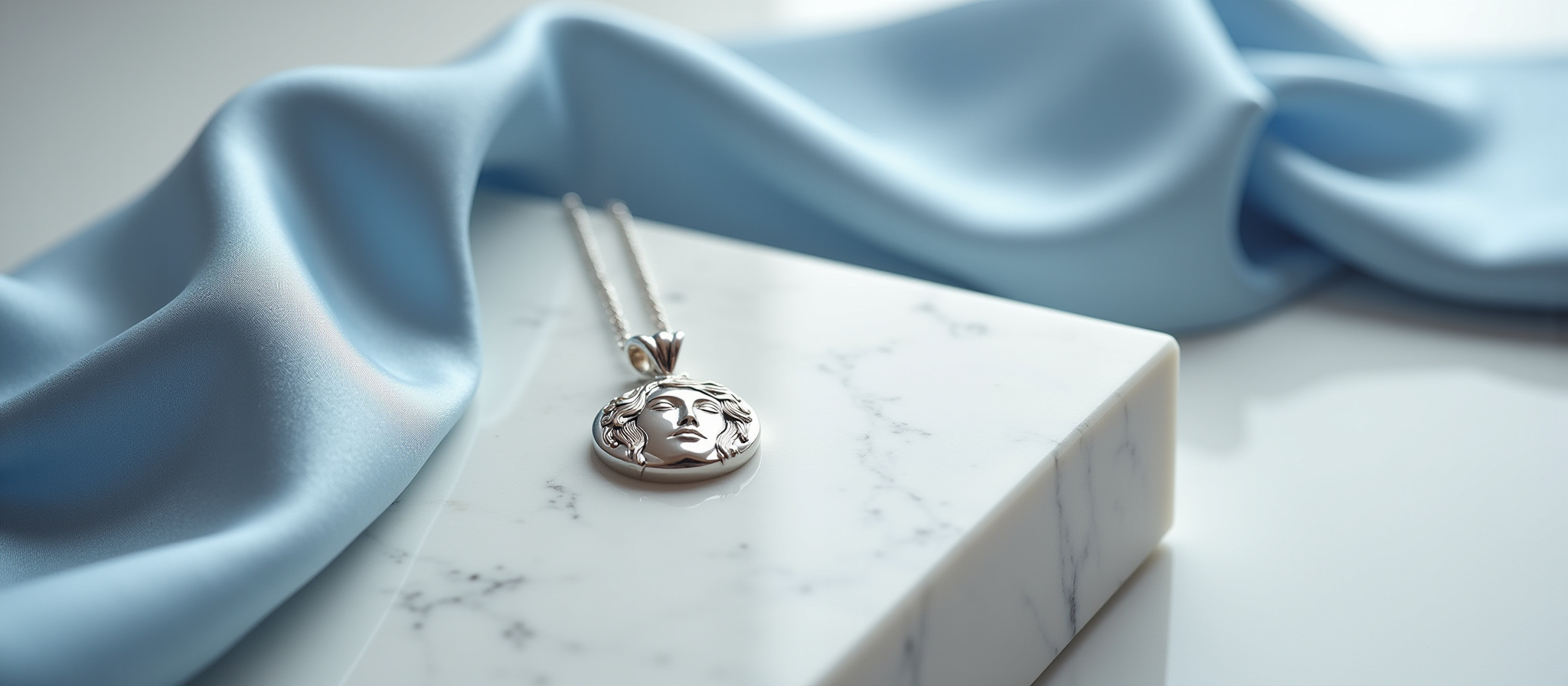
Personalized Jewelry for You
Celebrate Connections Through Technology
How It Works
Zâmbet uses a custom-built AI pipeline to transform a single headshot into a personalized jewelry pendant.
Below are actual outputs of Zâmbets algorithm, displaying both digital and physical manufacturing outputs.


Input a headshot
Receive a custom pendant
1. Facial Feature Segmentation
The process begins with image segmentation, where the input headshot is broken down into distinct facial regions such as eyes, nose, lips, ears, and cheeks.
This segmentation model is trained using the CelebA-Mask-HQ dataset, which contains over 30,000 publicly available, high-quality headshots with detailed facial annotations.


2. Feature Aware 3D Construction
Once segmented, each facial region is independently processed through a monocular depth estimation model based on the open-source MiDaS architecture. Isolating regions prevents depth errors caused by strong color contrasts.
For example, look at the eyes of the subject in the bottom right. The iris's darkness against the surrounding whites can cause the algorithm to incorrectly push it toward the back of the head.
3. Additional 3D Depth Construction
V2 of the Zâmbet pipeline, published in March 2026, leverages DECA, a method that reconstructs detailed 3D face geometry from a single image. Unlike traditional depth estimation, it excels at capturing fine-grained features like ears and teeth that other approaches typically miss.


4. Bas-Relief Generation
V2 fuses both depth estimations, cross-validating to filter features either method alone misses. The combined mesh is then flattened via a custom bas-relief algorithm operating on the spatial derivatives of vertex positions (Zhang et al., IEEE TVCG 2015), applying nonlinear gradient-domain compression to produce a compact height field while preserving fine surface detail.
5. Fabrication
The result is a highly personalized pendant that preserves the unique facial structure of the subject, created from a single photograph.
The prototype to the right is fabricated out of aluminum oxide. The same slurry based lithography techniques can be used to make the same parts out of any precious metal. A US quarter is placed next to the prototype for reference.

Future Products
Necklace
Personalized Jewelry
A custom-crafted pendant featuring a detailed portrait of your loved one. Made from high-quality materials with a delicate chain, each necklace is crafted to capture the likeness of someone special.
Bracelet
Wrist Adornments
A custom-designed bracelet adorned with miniature portrait charms of the people who matter most.
What's Next
Zâmbet is actively refining its model to reliably generate high-quality outputs. Using qualitative evaluation, the current system produces acceptable pendants approximately 50% of the time. Fine facial features, such as open eyes, teeth, and ears, remain the most challenging to reproduce. The near-term objective is to achieve high-quality digital outputs in 98% of a 1,000-image sample. Reaching this milestone will enable a fundraising round to support launch preparation.
Preparing for launch will focus on three core areas:
-
Marketing
-
Brand development
-
Website design
-
Digital marketing
-
-
Customer Interface
-
Develop a customer portal allowing users to generate a digital file at no cost
-
-
Manufacturing
-
Establish a production partnership with a contract manufacturer
-